
A novel can spend pages inside a character’s head.
The reader can follow a character’s memories, fears, observations, fantasies, doubts, contradictions, and thoughts without ever needing to see those things happen externally. A novelist can tell us exactly what a character is thinking and allow that internal experience to carry an entire chapter.
A screenplay does not have the same freedom.
Film is fundamentally an external medium. The audience experiences the story through what characters do, say, see, hear, and encounter. Even when a film explores a deeply internal character, the screenplay still has to give the eventual production something that can be performed, photographed, edited, and heard.
This creates one of the most difficult problems in book-to-screenplay adaptation: what do you do when the most important parts of your protagonist’s story happen inside their head?
The answer is not necessarily to turn a quiet protagonist into an action hero.
It is to find the dramatic behavior inside the character’s internal conflict.
A protagonist can be quiet, reluctant, contemplative, isolated, frightened, or emotionally restrained and still carry a compelling screenplay. The challenge is making that internal struggle visible enough for an audience to experience it.
Why Internal Protagonists Can Be Difficult to Adapt
Novels and screenplays communicate information differently.
A novelist can write: She knows she should leave, but the thought of starting over terrifies her.
A screenplay cannot simply depend on that sentence appearing on the page. The production needs to communicate the same conflict through something the audience can experience.
Perhaps she packs a suitcase, then puts everything back. Perhaps she buys a train ticket but never boards. Perhaps she tells her sister she is leaving, then cancels the reservation. Perhaps she watches her husband sleep and reaches for the suitcase before stopping herself.
Internal conflict has to create external behavior.
This is one of the central challenges in adapting a novel for film. The screenplay may not yet have found a dramatic expression for what is happening internally.
Passive Does Not Mean Quiet
One of the most common mistakes in adaptation is assuming that a protagonist needs to be constantly active to be cinematic.
That is not true.
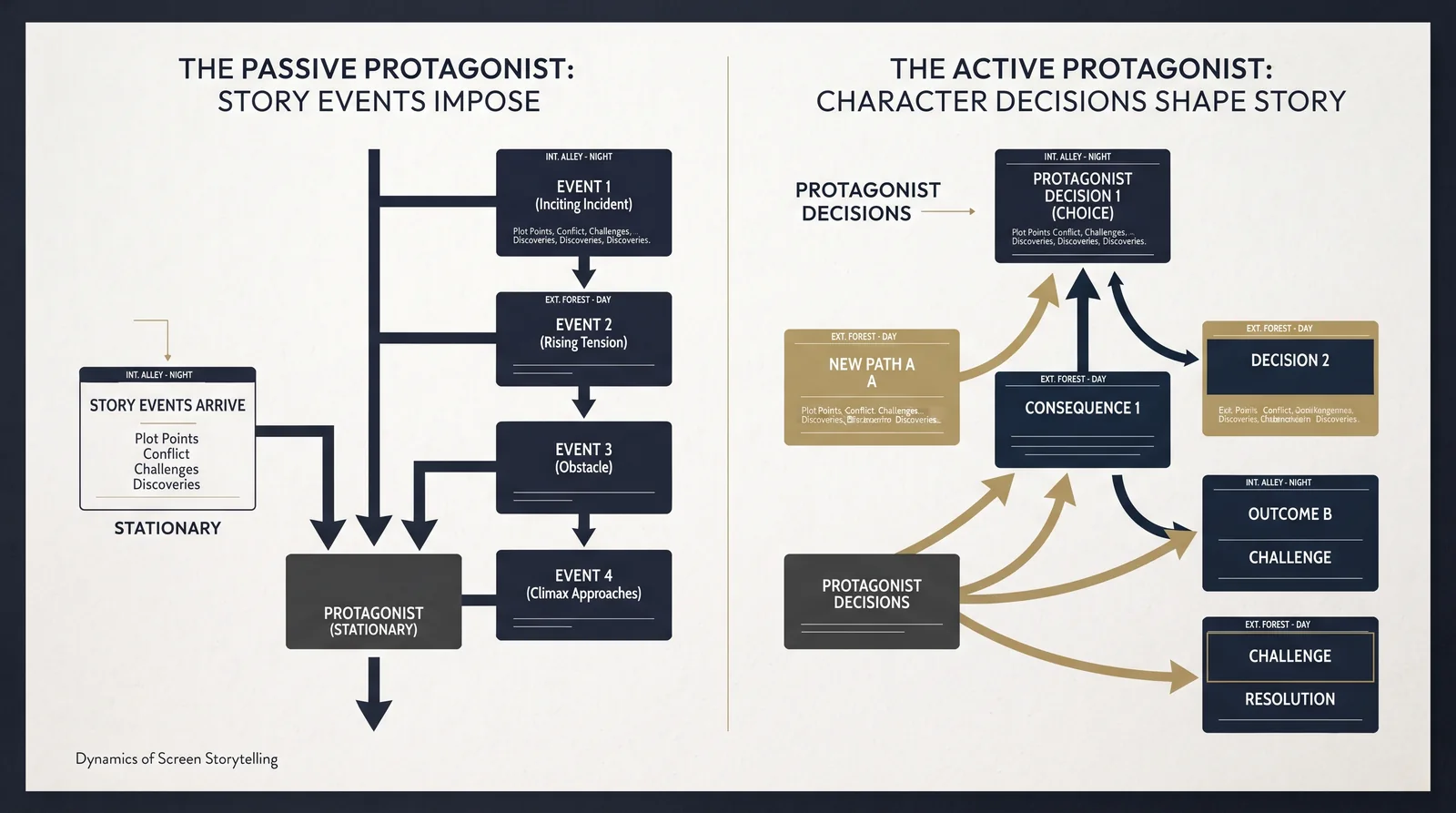
A character can spend much of a film sitting at a kitchen table and still be dramatically active if they are making decisions, pursuing something, withholding something, manipulating someone, resisting pressure, or gradually changing their behavior.
Conversely, a character can run through ten action sequences and still feel passive if the events are simply happening to them.
A physically active character is not necessarily a dramatically active character. Dramatic activity comes from intention. A protagonist wants something. Something stands in the way. The protagonist responds. That response creates another problem, opportunity, revelation, or consequence.
This creates movement even when the physical setting barely changes. For adaptation purposes, the useful question is therefore not “Is my protagonist active enough?” It is “Does my protagonist’s internal conflict produce meaningful choices?”
What Makes a Protagonist Dramatically Active?
A protagonist becomes dramatically active when their decisions influence the direction of the story. Consider a character who is terrified of confronting an estranged parent.
In the novel, much of the story might explore the character’s memories and conflicting feelings about the relationship.
For the screenplay, the adaptation might build the conflict through a series of choices: the protagonist ignores the parent’s phone calls, secretly listens to an old voicemail, agrees to attend a family gathering, discovers information that changes their understanding of the past, confronts another family member, decides to return to the family home, and finally confronts the parent.
The character does not need to become fearless. In fact, the fear may be what makes the choices interesting. The dramatic progression comes from what the character does because of that fear.
The Difference Between Internal Conflict and Dramatic Conflict
Internal conflict and dramatic conflict are closely connected, but they are not the same thing.
Internal conflict exists within the character. Dramatic conflict emerges when that internal struggle affects the character’s relationship with the world around them.
For example: Internal conflict — a woman believes she caused her brother’s death and cannot forgive herself. External expression — she refuses to attend the family’s annual gathering. Dramatic complication — her mother tells her that the family has discovered evidence that may change what happened. Choice — she returns home despite knowing that confronting the past could destroy the version of events she has used to live with her guilt.
The internal conflict remains central. The screenplay simply gives it something to spark the fire. This is where cinematic storytelling begins.
Turning Thoughts Into Actions
When adapting a novel, one useful exercise is to identify the protagonist’s most important internal statements and ask what each one could cause the character to do. Suppose the novel contains an important idea: he believes nobody will ever love him if they discover what he has done.
Rather than searching for a literal way to communicate that thought, examine its dramatic consequences.
Does he avoid intimacy? Does he lie when someone asks about his past? Does he sabotage a relationship when it becomes serious? Does he destroy evidence? Does he push someone away immediately after they express affection? Does he confess to the wrong person?
The screenplay needs to dramatize the belief. This distinction is critical in a novel to screenplay adaptation. The goal is to preserve the dramatic function of that information.
Use Behavior to Reveal Character
One of the strongest tools available to a screenwriter is behavior. People reveal themselves through what they do when nobody tells them what to do. A character who says, “I’m not afraid of him,” gives the audience information. A character who hears a car pull into the driveway, stops what they are doing, locks the door, and turns off the lights gives the audience an experience.
The second approach may communicate more about the character without explaining anything. This becomes particularly valuable when adapting literary fiction, memoir, psychological drama, and character-driven stories.
Instead of explaining fear, show avoidance. Instead of explaining guilt, show self-punishment, secrecy, or attempts to repair the consequences. Instead of explaining loneliness, show how the character behaves when someone finally offers connection. Instead of explaining ambition, show the choices the character makes when success conflicts with loyalty. Instead of explaining jealousy, show what the character does after witnessing the person they love with someone else.
The exact behavior will depend on the character. That is why adaptation cannot be reduced to a mechanical conversion process.
Internal Monologue Is Not Automatically the Enemy
There is an important caveat. Internal storytelling is not forbidden in film.
Voice-over, subjective imagery, sound design, visual metaphor, dreams, flashbacks, and other cinematic techniques can communicate internal experience. The problem occurs when these techniques become substitutes for dramatic storytelling rather than tools within it.
If a character spends several minutes explaining exactly what they are thinking through voice-over while the images contribute little additional information, the adaptation may still feel like a novel being read aloud.
The stronger approach is often to ask whether the internal information can be communicated through the scene itself. The decision should come from the story and the intended cinematic form, not from a blanket rule that internal narration is either always good or always bad.
Find the Character’s Want
A useful starting point in adaptation is identifying what the protagonist wants in concrete terms. This does not have to be the deepest emotional need of the character. It is the immediate objective that can drive behavior.
A protagonist might want to find her missing brother, get her child back, leave an abusive relationship, protect a family business, discover who committed a crime, convince someone to forgive him, finish a project before a deadline, escape a dangerous situation, reconcile with an estranged parent, or prevent a secret from being exposed.
The internal conflict complicates the pursuit of that objective.
A character may desperately want something while simultaneously being afraid of what achieving it would require. That contradiction creates useful dramatic material.
Give the Internal Conflict a Cost
An internal struggle becomes more compelling when it affects the protagonist’s external life. Imagine a character who is unable to trust people because of a previous betrayal. That belief becomes dramatically useful when trust is necessary.
The protagonist may need information from someone they distrust. They may need to accept help. They may need to reveal a secret. They may need to depend on another person during a crisis. The character’s internal limitation now interferes with the external objective.
That creates pressure. And pressure creates scenes.
This is one reason strong adaptations often preserve the emotional architecture of the source material rather than attempting to preserve every event.
What Happens to Subplots?
Internal protagonists often come with complex literary structures. A novel may contain multiple relationships, memories, secondary characters, parallel timelines, thematic digressions, and subplots that deepen the protagonist’s psychology.
A screenplay may not have room for all of them. That does not mean they are automatically useless. The adaptation process should ask what function each subplot performs.
Does it reveal something important about the protagonist? Does it create a meaningful obstacle? Does it change the protagonist’s decisions? Does it establish information needed later? Does it reinforce the central theme? Does it create an important relationship or consequence?
If a subplot exists primarily because the novel has hundreds of pages to accommodate it, it may not survive the transition. If it is essential to understanding the protagonist’s central dramatic journey, it may need to be preserved in a different form.
This is where professional adaptation requires judgment.
The Protagonist May Need to Do Less
There is another misconception worth addressing.
Making an internal protagonist more cinematic does not necessarily mean adding more plot.
Adding explosions, confrontations, twists, arguments, or dramatic events can create activity without creating character development. A protagonist who was originally quiet can become artificially aggressive.
A subtle family drama can suddenly become a conspiracy thriller. A reflective literary story can acquire unnecessary action sequences simply because someone believes the screenplay needs to be “more cinematic.”
That can damage the adaptation.
The Character Arc Still Needs to Be Visible
A character’s internal transformation can be subtle, yet memorable. At the beginning of the screenplay, the protagonist may respond to a particular situation in one way. Later, the same type of situation may produce a different choice. That contrast can communicate an arc without requiring the character to explain what they have learned.
For example: at the beginning, a character refuses to confront a painful truth. Later, they have an opportunity to confront it and walk away. Near the end, the same opportunity appears again, but this time they choose to face it. The audience understands that something has changed.
The screenplay has dramatized the transformation.
A Practical Test for Your Adaptation
If you are adapting your own novel, take the protagonist’s five most important internal conflicts and write them down.
For each one, ask: what does this belief make the character do? Then ask: what does that action cause to happen? Then: what choice does the character have to make because of that consequence? Finally: does the choice change the direction of the story?
If the answer is consistently yes, the internal material probably has a path into the screenplay.
If the answer is consistently no, you may have identified material that works beautifully as prose but does not yet have a dramatic function on screen.
When an Internal Protagonist Becomes a Structural Problem
Sometimes the issue is deeper than individual scenes. If the protagonist spends most of the story observing events without influencing them, the screenplay may have a structural problem. The character might witness a mystery rather than investigate it. Experience a relationship rather than make choices within it. React to other people’s decisions rather than pursuing an objective of their own. In those cases, adding isolated “active” scenes may not solve the underlying problem.
The adaptation may need to reconsider the protagonist’s role in the story. That could mean changing the sequence of events, consolidating characters, restructuring the central conflict, or finding a clearer objective. These are significant adaptation decisions.
They should be made carefully because changing the protagonist’s dramatic function can affect the entire screenplay.
The Best Adaptation Preserves What Made the Character Worth Adapting
There is a temptation during adaptation to make everything more obvious. Make the protagonist louder, the conflict bigger, the villain more threatening. Sometimes those changes are necessary. But they can also destroy the qualities that made the original work distinctive.
The adaptation simply has to give those qualities cinematic expression. That may come through behavior, relationships, choices, visual storytelling, recurring actions, setting, objects, silence, performance, or the consequences of decisions.
Considering a Book-to-Screenplay Adaptation?
At ScreenwritePro, we approach adaptation as a development process rather than a mechanical transfer from manuscript to screenplay. We examine the source material, identify its central dramatic story, determine what can be preserved or transformed, and develop the material for the requirements of film or television.
If you are considering adapting a novel, memoir, or other published work, explore our Book-to-Screenplay Adaptation service to learn more about the process.
You can also explore our Script Coverage service if you already have a screenplay and want an independent assessment before further development.