For an author, hearing that a producer wants to option the film rights to your book can feel like the moment the Hollywood dream becomes real.
It is an important step.
But an option is not the same thing as a sale. It does not necessarily mean a movie is going into production. It does not mean the producer has purchased the rights outright. And it certainly does not guarantee that the book will become a film.
Understanding the difference matters because the financial and practical consequences can be significant.
A film or television adaptation usually develops through several stages. A producer may first become interested in the underlying intellectual property, negotiate an option, develop the project, approach potential financing or production partners, attach talent, commission screenplay work, and eventually decide whether to exercise the purchase rights.
Sometimes the process leads to production; sometimes the option expires; sometimes the project changes hands or remains in development for years.
For authors and publishers considering a screen adaptation, understanding what is being offered at each stage is more useful than simply hearing that a book has been “optioned.”
What Does It Mean When a Book Is Optioned?
An option agreement generally gives the producer or production company the exclusive right, for a specified period, to acquire or exercise certain rights in the underlying property under the terms negotiated in the agreement.
The author or rights holder receives compensation for granting that option. The important point is that the producer has obtained a period of control over the relevant rights without necessarily purchasing them outright. The exact structure varies from deal to deal.
An option might give the producer a defined period to develop the project and decide whether to proceed with the acquisition. It may contain renewal or extension provisions. It may specify what happens if the option expires. It may also address sequels, remakes, television rights, merchandising, publication, and other rights.
These terms are contractual and can vary substantially. For that reason, an author should not assume that every option agreement works the same way.
The Writers Guild of America treats options and purchases as distinct transactions within its contractual framework for covered writers. Its guidance also emphasizes that individual agreements contain negotiated provisions beyond the applicable Guild minimums. (Writers Guild of America West)
For book authors, the specific rights involved will depend on the underlying publishing and intellectual-property agreements rather than simply on WGA rules.
What Does It Mean When Film Rights Are Sold?
A sale generally involves the transfer or acquisition of the negotiated rights to exploit the underlying property for the specified purpose. For a book adaptation, that could involve rights allowing a producer or production company to develop and produce a film or television project based on the book.
The exact rights transferred or licensed depend on the agreement. This distinction is important because “selling the film rights” does not necessarily mean giving away every right associated with the book.
A rights agreement can define precisely what the buyer receives and what the author or publisher retains. Depending on the deal, rights may be divided into categories such as:
- Film rights
- Television rights
- Sequel rights
- Remake rights
- Publication rights
- Stage rights
- Merchandising rights
- Interactive or gaming rights
- Foreign or territorial rights
- Other derivative rights
The exact treatment of these rights is a matter for the agreement and the parties’ legal advisers. The general principle is simple: the rights being transferred or licensed should be clearly defined.
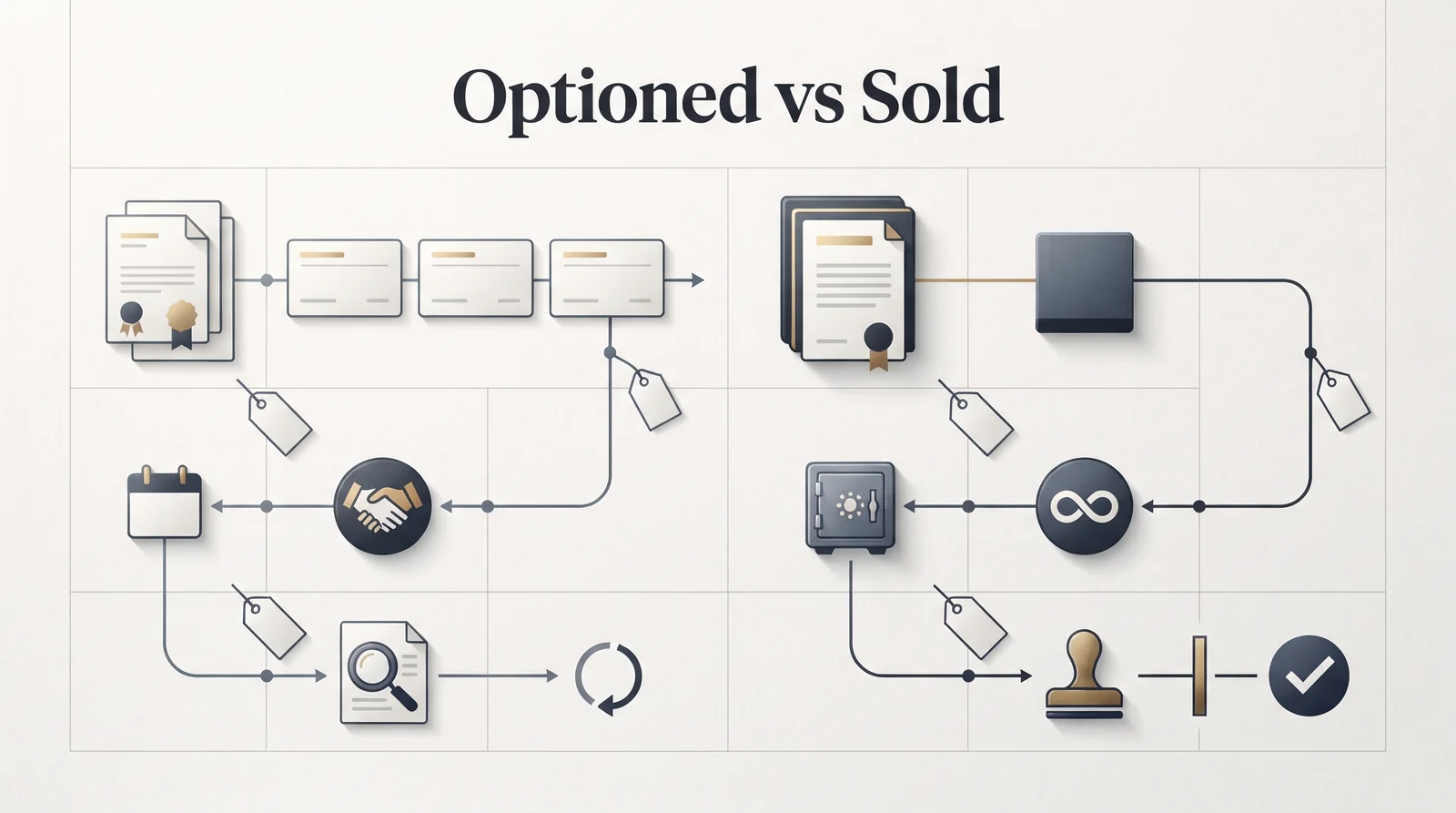
Optioned vs. Sold: The Basic Difference
The easiest way to understand the distinction is to think about control and timing.
An option
The producer obtains a contractual opportunity to acquire or exercise the agreed rights during a specified period.
A sale or acquisition
The buyer acquires the agreed rights according to the terms of the purchase agreement.
An option can therefore be thought of as a period during which the producer secures the opportunity to move the project forward before completing the larger rights transaction. This gives the producer time to determine whether the project can realistically be developed.
The producer may need to:
- Develop the screenplay
- Find financing
- Attach a director
- Approach actors
- Build a producing team
- Find distribution
- Assess the budget
- Present the project internally
- Determine whether the project fits its slate
The author receives compensation for granting the option, while the producer obtains time and a degree of exclusivity to pursue the project.
Does an Option Mean the Book Will Become a Movie?
No. This is one of the most important distinctions authors should understand.
Optioned does not mean produced.
A producer can option a book because they believe it has potential, then ultimately decide not to proceed. The project may encounter financing difficulties. The screenplay may require more development than expected. The intended budget may become unrealistic. The producer may fail to attach the necessary talent. The company may change its priorities. The market may change. The option may even simply expire.
None of these outcomes necessarily means the original book was unsuccessful. Film and television development involves many factors beyond the quality of the underlying intellectual property.
An option is therefore better understood as a development and rights transaction, not a production guarantee.
Why Would a Producer Option a Book Instead of Buying It Immediately?
Because development involves uncertainty.
A producer may believe strongly in a book while still needing time to determine whether it can become a viable screen project. The producer may want to investigate questions such as:
What is the strongest film or television version of this story? Who could write the screenplay? What format makes sense? What would the project cost? Who could direct it? Who might star in it? Which buyers might be interested? Can the project attract financing?
An option can give the producer time to answer some of those questions while securing the relevant rights for the agreed period. That can make an option useful for both sides. The producer gets time to develop. While the rights holder receives compensation and potentially gains an industry partner pursuing the adaptation.
How Much Money Does an Author Receive for an Option?
There is no universal price that applies to every book. Option compensation can vary based on factors such as:
- The popularity of the book
- Existing sales
- Author profile
- Existing adaptation interest
- Genre
- Rights availability
- Potential film or television format
- The buyer or producer
- Budget expectations
- Negotiating leverage
- The scope of rights being granted
- The length of the option period
A well-known bestseller with substantial adaptation interest can present a very different negotiating situation from an independently published novel with limited commercial history. The same applies to the eventual purchase price.
There is no single percentage that authors should assume their book will command simply because it has been optioned. Entertainment agreements are negotiated individually, and the value of a property depends on considerably more than the number of pages in the book.
The Option Fee Is Not Necessarily the Purchase Price
This is another distinction that is often misunderstood. An option payment and the eventual purchase price can be separate components of a rights transaction.
An agreement may specify an option payment for the initial option period and a separate amount payable if the producer exercises the option and acquires the agreed rights. The contract may also contain extension payments or other negotiated compensation.
Exactly how those payments are structured depends on the agreement. This is one reason authors should examine the complete deal rather than focusing only on the initial amount being offered.
A small option payment can exist alongside a substantially larger purchase price. Conversely, a larger option payment does not automatically mean the overall deal is favorable.
What Happens If the Producer Exercises the Option?
If the producer exercises the option according to the agreement, the transaction moves into the next stage defined by the contract. That could involve the producer acquiring the agreed rights for the specified purchase price or triggering another contractual arrangement.
At that point, the project may still need substantial development. The producer may commission additional screenplay work, attach talent, seek financing, package the project, approach distributors, or pursue other production requirements. This is why even an exercised option does not necessarily mean cameras are about to roll.
There can still be a considerable distance between rights acquisition and production.
What Happens If the Option Expires?
The answer depends on the agreement. In some cases, the producer may have negotiated extension rights. Those extensions may require additional payments or satisfy other conditions.
If the applicable rights return to the author or rights holder after expiration, the property may become available for another potential transaction, subject to the terms of the original agreement and any continuing rights or obligations. The precise result depends on the contract.
Authors should therefore understand:
- The initial option period
- Any extension periods
- Extension payments
- Exercise provisions
- Reversion provisions
- Rights retained by the author
- Rights retained by the publisher
- Any restrictions that survive expiration
These provisions can matter as much as the headline option amount.
Why the Option Period Matters
An option can tie up important rights for a period of time. During that period, the rights holder may be unable to grant the same rights to another producer because of the exclusivity granted under the agreement. That makes the length and structure of the option commercially significant.
Imagine that an author grants a producer an option for two years. The producer develops the project but does not move forward. If the agreement provides for extensions, the producer may have additional time to continue pursuing it. The author may therefore spend several years with the adaptation rights committed to a project that ultimately does not reach production.
This is one reason the option period and extension provisions deserve careful attention.
What Makes a Film Rights Deal Valuable?
Authors sometimes focus almost entirely on the dollar amount. That is understandable.
But the value of a rights deal is not necessarily captured by one number. Consider the entire structure.
- Financial compensation — What is paid for the initial option? What is payable upon exercise? Are there extension payments? Are there additional compensation provisions?
- Duration — How long does the producer control the relevant rights?
- Scope — Exactly which rights are being granted?
- Reversion — What happens if the project is not produced?
- Development obligations — Does the agreement require certain development activity?
- Credit — What credit provisions apply to the author?
- Consultation or approval rights — Does the author retain any negotiated consultation or approval rights?
- Sequels and derivative works — How are future projects based on the property handled?
- Territory — Are the rights worldwide or limited to particular territories?
- Format — Does the agreement cover only a feature film, or does it also include television and other formats?
These provisions can materially affect the practical value of the deal.
Why Authors Should Understand Their Rights Before Developing the Screenplay
A book may have substantial screen potential, but that potential needs to be evaluated before significant development resources are committed.
One useful question is: what exactly is being developed?
A property may be better suited to a feature film, a limited series, an ongoing television series, a documentary, a television movie, or another screen format.
The answer can affect the adaptation strategy.
A sprawling family saga may struggle as a two-hour feature but have enough material for a limited series. A tightly constructed thriller may be more naturally suited to a feature. This is where professional development can help before the rights holder begins approaching potential buyers.
Does Having a Screenplay Increase the Value of Film Rights?
It can make the property easier to evaluate, but there is no guarantee that a completed screenplay will increase the financial value of the underlying rights.
A strong screenplay can demonstrate what the property could look like on screen. It can help communicate the central story, character arcs, structure, tone, genre, dramatic stakes, and cinematic potential.
For a producer considering a property, this can be useful development material. But authors should avoid assuming that commissioning a screenplay automatically makes their book more valuable in financial terms.
The quality of the screenplay, the underlying IP, market interest, rights position, and buyer demand all matter. The purpose of professional adaptation should therefore be to develop the strongest screen version of the property, not to manufacture an artificial valuation.
What Authors Should Ask Before Signing a Film Rights Agreement
Before signing an option or purchase agreement, authors and rights holders should have qualified entertainment counsel review the actual contract.
Some useful questions to discuss with counsel include: What rights am I granting? How long will those rights be controlled by the producer? What happens if the producer does not make the film? Can the producer extend the option? What does each extension cost? What happens to the rights when the agreement expires? What happens if the producer sells or transfers the project? Are television, sequel, remake, merchandising, or other rights included? What compensation becomes payable if the option is exercised? What credit provisions apply? Do I retain any consultation or approval rights? Are there any existing publishing or other agreements that affect the rights being granted?
These are contractual questions. They should be addressed with an attorney who can advise on the specific agreement and jurisdiction.
The Difference Between a Screenplay and a Film Rights Deal
There is another distinction worth making.
A professional screenplay can help develop and present a property. It does not itself create a film rights transaction. An author can have an excellent screenplay and no option. An author can also have a book optioned before a screenplay exists.
The two processes can intersect, but they are not the same thing. Screenplay development is about the screen version of the story. A rights deal is about who controls and can exploit the relevant intellectual property, under what terms and for how long.
Where Book-to-Screen Development Fits Into the Process
For authors and publishers, the strongest approach is often to consider the screen potential of a property before approaching producers. That can involve an adaptation assessment, treatment, screenplay, pitch materials, or another development document depending on the property’s stage.
The goal is to answer a fundamental question: what is the strongest screen version of this intellectual property?
Once that question has been explored, the rights holder is in a stronger position to understand what is being presented to potential industry partners. The development process may identify that the book is best suited to a feature. It may reveal that a limited series is a better fit.
It may uncover structural problems that need to be addressed before the property is presented. Or reveal that the existing book is strong enough to serve as the foundation for a screenplay with relatively limited restructuring.
The Real Financial Question for Authors
The question is not simply: “How much can I sell my book for?”
A more useful question is: “What rights am I granting, for how long, to whom, and under what conditions?”
The financial amount matters. But so do the rights, duration, extension provisions, reversion terms, scope of exploitation, and other contractual provisions. A $10,000 option with favorable terms can present a different situation from a $20,000 option that grants broader rights for a longer period.
Likewise, a purchase agreement needs to be evaluated based on the complete package rather than one headline figure. That is why professional legal advice matters when an actual offer arrives.
What ScreenwritePro Can Do Before You Approach the Market
ScreenwritePro focuses on the development side of the process.
For authors, publishers, and rights holders considering a screen adaptation, we can help determine how the source material can be translated into a professional screenplay or other development material.
Our book-to-screenplay adaptation process examines the source material, identifies the central dramatic story, determines what can work cinematically, and develops the material into a screenplay appropriate to the intended format.
Depending on the project, development may also involve treatments, pitch materials, coverage, or other written development documents. The objective is not to promise that a screenplay will be optioned or produced.
No legitimate screenwriting service can make that guarantee.
The objective is to give the property a stronger professional foundation before it is presented for further consideration.
ScreenwritePro has developed more than 100 screenwriting and development projects across different genres and formats. Projects that meet our internal criteria may also be eligible for our internal vetting process and potential submission through our professional relationship with Brendan Deneen, President of Literary & Development at Blackstone Publishing.
Submission does not guarantee that a project will be read, requested, represented, optioned, sold, or produced.
Explore ScreenwritePro’s Book-to-Screenplay Adaptation Service