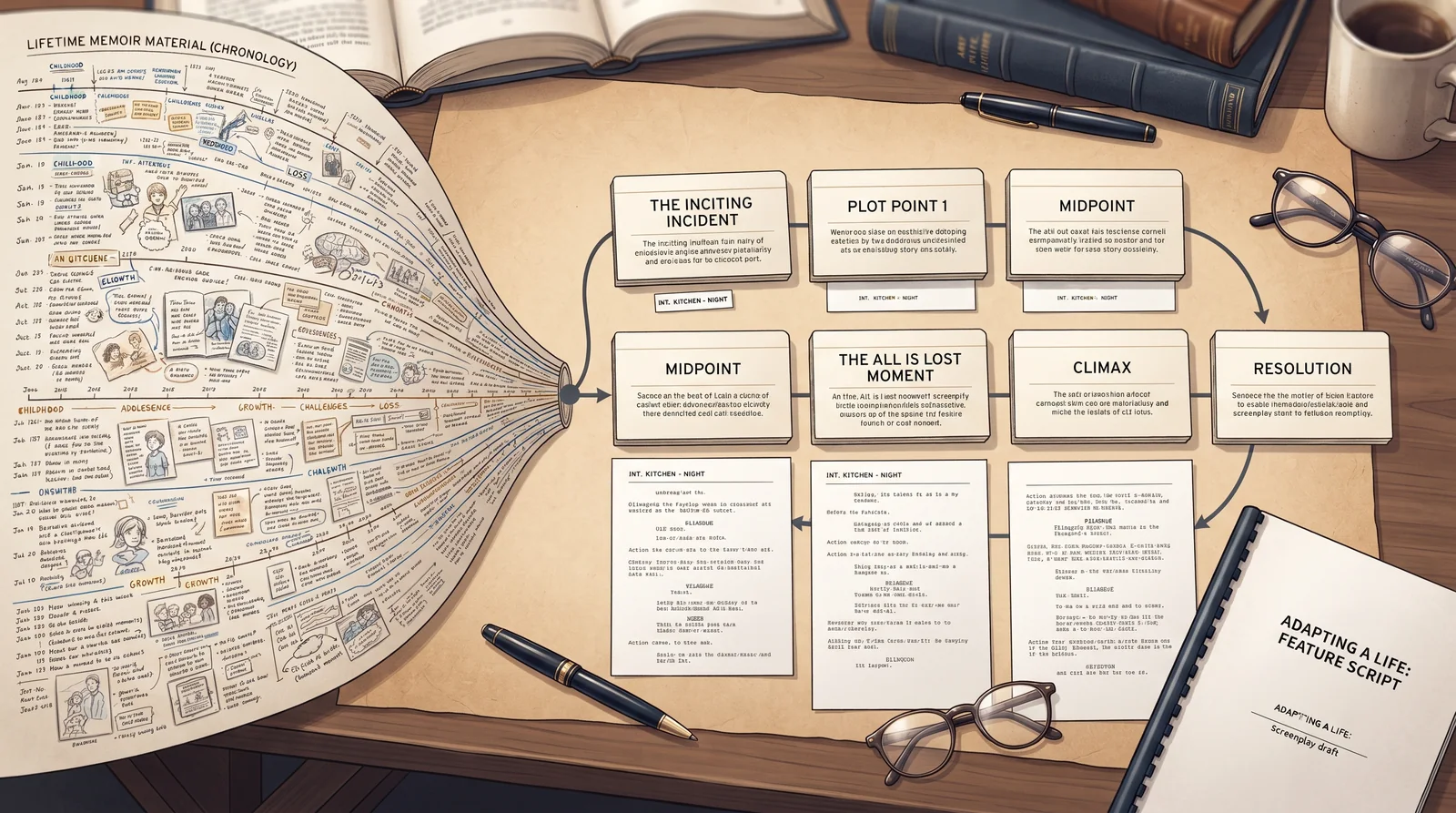
A memoir can contain an entire life. A screenplay cannot.
That is one of the first realities an author encounters when trying to turn a memoir into a movie.
A book may cover twenty years, several relationships, multiple careers, family histories, personal discoveries, major setbacks, and years of emotional development. A feature screenplay has a much more limited amount of time to tell its story.
The temptation is to treat the memoir like a checklist.
The challenge in memoir-to-screenplay adaptation is not simply deciding what to cut, but determining which part of the life story the movie is actually about.
A Memoir Is Not Automatically a Movie
A memoir and a screenplay can tell the same underlying story while using completely different structures.
A memoir may be organized around memory, reflection, themes, chronology, or a series of significant experiences. The author can move backward and forward through time, explain what they were thinking years earlier, provide context, and reflect on events with the knowledge they gained later.
A screenplay has different demands. The audience needs to understand what is happening now, who wants what, what is preventing them from getting it, and why the outcome matters.
That does not mean every memoir needs to become a conventional three-act movie.
It means that if the intended adaptation is a feature screenplay, the source material generally needs to be shaped into a dramatic progression that can sustain the film’s running time. The three-act structure can provide one way to do that.
But it should be used as a framework for the story, not as a machine that forces every life into identical beats.
The First Question: What Is the Movie About?
Before dividing a memoir into Act One, Act Two, and Act Three, identify the central story.
This sounds straightforward.
For many memoirs, it is the hardest part. A life contains many stories. A person may have experienced childhood trauma, built a career, fallen in love, lost a parent, started a business, survived a crisis, moved countries, repaired a family relationship, and discovered something important about themselves.
All of those experiences may matter to the author, but they do not necessarily belong in the same movie. A useful adaptation question is: if the screenplay could only tell one chapter or period of this person’s life, which one contains the strongest dramatic story?
The Difference Between a Life Story and a Movie Story
Consider a fictional memoir covering thirty years of someone’s life.
The memoir includes a difficult childhood, leaving home at eighteen, university, a first serious relationship, a failed business, a second career, marriage, the death of a parent, a major professional opportunity, a family conflict, reconciliation, and a new beginning.
All of these events may be meaningful.
But suppose the strongest dramatic story is actually the period surrounding the failed business. The screenplay might begin shortly before the business is launched, establish what the protagonist wants, introduce the pressures threatening the venture, develop the relationships affected by the struggle, and bring the character to a decisive confrontation with the consequences of failure.
The earlier childhood material may still matter. But it may only need to appear when it provides necessary context for the protagonist’s choices. The later events may not belong in the feature at all. That is not a failure to respect the memoir. It is an adaptation decision.
Act One: Establish the Life Before It Changes
In a three-act structure, Act One establishes the protagonist, their circumstances, their relationships, their immediate objective, and the situation that disrupts the existing order. For a memoir adaptation, this becomes particularly important because the source material may contain years of background. The screenplay cannot spend its opening pages explaining the protagonist’s entire life.
Start with the dramatic present
If the central story concerns a marriage falling apart, the screenplay may not need twenty pages about the protagonist’s childhood before the marriage appears.
The question is always: what does the audience need to understand before the central conflict begins? Everything else can be evaluated against that question.
The protagonist needs an objective
The protagonist’s goal may change during the story, but the screenplay benefits from giving the audience something concrete to follow.
Perhaps the protagonist wants to save a failing company, leave an unhealthy relationship, win a particular case, reconcile with a parent, protect a child, complete a difficult project, escape a dangerous environment, rebuild a life after a major loss, or prove themselves professionally.
The objective gives the story direction.
The disruption
Something eventually disturbs the protagonist’s existing life. This could be an event, discovery, decision, opportunity, loss, confrontation, or consequence. In a memoir adaptation, the disruptive event does not necessarily have to be the single most dramatic event in the person’s life.
It needs to be the event that launches the story the screenplay has chosen to tell. By the end of Act One, the audience should have a reasonable understanding of the protagonist’s situation and the problem that is beginning to drive the story.
Act Two: Make the Consequences Escalate
Act Two is where many memoir adaptations become difficult. Life does not naturally escalate like a screenplay. Real people experience good years, bad years, quiet periods, unexpected interruptions, unrelated problems, and events that have little connection to one another.
A movie needs stronger causal progression.
The protagonist makes a decision → that decision creates a consequence → the consequence creates a new problem → the protagonist responds → that response creates another consequence → the situation becomes increasingly difficult.
This does not mean every scene has to contain a dramatic twist.
Combine events when necessary
A memoir can contain several people who played similar roles at different points in the author’s life. A screenplay may not need all of them.
Similarly, a series of smaller events may perform the same dramatic function as one stronger sequence. An adaptation might therefore consolidate material. Several minor professional setbacks can combine to become a major setback.
Multiple conversations might become one confrontation. Several trips might become one decisive journey. The purpose is not to distort the author’s experience casually. We want to create a screenplay that can communicate the central story within the constraints of the medium.
For memoirs based on real people, these decisions can also raise legal, ethical, and rights considerations that should be evaluated separately from the creative adaptation itself.
The Midpoint: When the Story Changes Direction
The midpoint is often useful in shaping the second half of a feature screenplay. The protagonist’s understanding of the situation may change.
A victory may create a larger problem. A discovery may undermine what the protagonist previously believed. A relationship may take a new direction. A seemingly achievable objective may become much more difficult.
For a memoir adaptation, the midpoint can be especially useful because real-life stories often contain a moment when the protagonist’s understanding of their circumstances changes. That moment may already exist in the memoir. If it does not, the adaptation needs to identify a different structural turning point from the available material.
The Second Half of Act Two
After the midpoint, the consequences should generally become more difficult. The protagonist has learned something. They may have achieved something. They may have lost something. Whatever has happened, returning to the previous version of their life should become increasingly difficult.
This is where the adaptation can draw on the memoir’s most consequential material. The protagonist’s choices should carry increasing costs. The protagonist may also begin to understand that solving the external problem requires confronting an internal one. Again, this does not mean inventing a psychological lesson. The memoir itself should provide the material from which that transformation is developed.
Act Three: The Final Choice
The third act brings the central dramatic conflict to its decisive stage.
For a memoir adaptation, this can be difficult because the real person’s life may continue long after the most important dramatic conflict has been resolved. A screenplay does not necessarily need to show everything that happened afterward.
It needs to decide where the story has reached a satisfying dramatic conclusion. The protagonist may finally make a decision they have avoided throughout the story.
They may confront a person, accept a loss, leave a relationship, return home, take responsibility, reject an opportunity, or decide to move forward without the resolution they originally wanted.
The ending should arise from the story that the screenplay has established.
The Ending Does Not Have to Be the End of the Person’s Life
A movie does not have to conclude when the person’s life story concludes.
Imagine a memoir that continues for another twenty years after the protagonist resolves the central conflict. Those twenty years may be fascinating. They may also belong to another story.
The feature might end shortly after the central resolution, perhaps with a brief epilogue if later information provides meaningful context. The purpose is to leave the audience with a sense that the story they followed has reached its appropriate conclusion.
What About Childhood?
Childhood material is one of the biggest traps in memoir adaptation. Authors understandably consider childhood experiences important because they explain who they became. But explanation and drama are not always the same thing. A childhood event should generally earn its place in the screenplay by contributing something to the central story.
It might explain a crucial relationship, a defining fear, a recurring behavior, a significant motivation, a central conflict, or a decision made later in the story.
If a childhood sequence only tells the audience that something happened a long time ago, it may be better handled more economically.
Flashbacks Can Help. They Can Also Create Problems.
Memoirs naturally encourage flashbacks because memory is part of the form. That does not mean every important memory should become a flashback. Flashbacks work best when the past actively affects the present story.
If the protagonist discovers something in the present that causes them to remember an important event, the past can deepen the current conflict. If a flashback simply pauses the story to provide information, it may weaken momentum.
The adaptation should therefore ask: why does the audience need this information here?
What Should Be Cut From a Memoir?
There is no universal list. However, adaptation often requires examining material such as:
Repetitive experiences — If several events demonstrate the same aspect of the protagonist’s character, one strong example may be enough.
Background that does not affect the central story — Interesting biography does not automatically become useful screenplay material.
Secondary relationships — A relationship may be important to the author’s life without being necessary to the particular movie being developed.
Long periods without meaningful dramatic change — Time can be compressed when nothing significant changes the protagonist’s objective, relationships, circumstances, or understanding.
Cutting these elements means that the screenplay has to make difficult decisions about what the audience needs to experience.
What Should Be Protected?
The opposite problem is cutting so aggressively that the adaptation loses its identity. Some material should receive particular attention because it defines the source.
This may include the central relationship, the defining conflict, a distinctive setting, a key period in the protagonist’s life, a defining decision, a recurring theme, an event that fundamentally changes the protagonist, and a unique perspective that distinguishes the memoir from similar stories.
The adaptation should know what makes this memoir this memoir.
A Practical Three-Act Test for Your Memoir
Before writing the screenplay, try reducing the memoir to three questions.
Act One — What is the protagonist’s existing life, and what happens that forces the central story to begin?
Act Two — What does the protagonist do in response, and how do those choices make the situation increasingly difficult?
Act Three — What final choice or confrontation resolves the central dramatic question?
If those questions cannot be answered clearly, the adaptation may not yet have identified its central story.
Can Every Memoir Become a Feature Film?
No.
Some memoirs may be better suited to a limited series. Others may work better as documentaries. Some may require substantial restructuring before they have a viable dramatic feature. And some may contain valuable material but lack a sufficiently focused central conflict for a conventional feature screenplay.
That assessment should happen before a large amount of screenplay drafting begins. The intended format matters.
A story spanning several decades may be suitable as a limited series in ways it cannot as a two-hour feature. A tightly focused personal crisis may be better suited to a feature. The source material should determine the format as much as the format determines the adaptation.
Thinking About Turning Your Memoir Into a Screenplay?
ScreenwritePro develops memoirs and book-to-screenplay adaptations by examining the source material, identifying the strongest dramatic story, and shaping it for the intended screen format.
The adaptation process can involve restructuring chronology, condensing events, reducing supporting characters, translating internal experiences into cinematic action, and determining which elements of the source material should remain central.
Learn more about our Memoir-to-Screenplay Adaptation service.
If you already have a screenplay draft and need an independent assessment before further development, you can also explore our Script Coverage service.