Every year, tens of thousands of screenplays are registered with the WGA. Less than 1% ever make it to a screen. For the average author or independent creator, the question is: how do I get a producer to read my script?
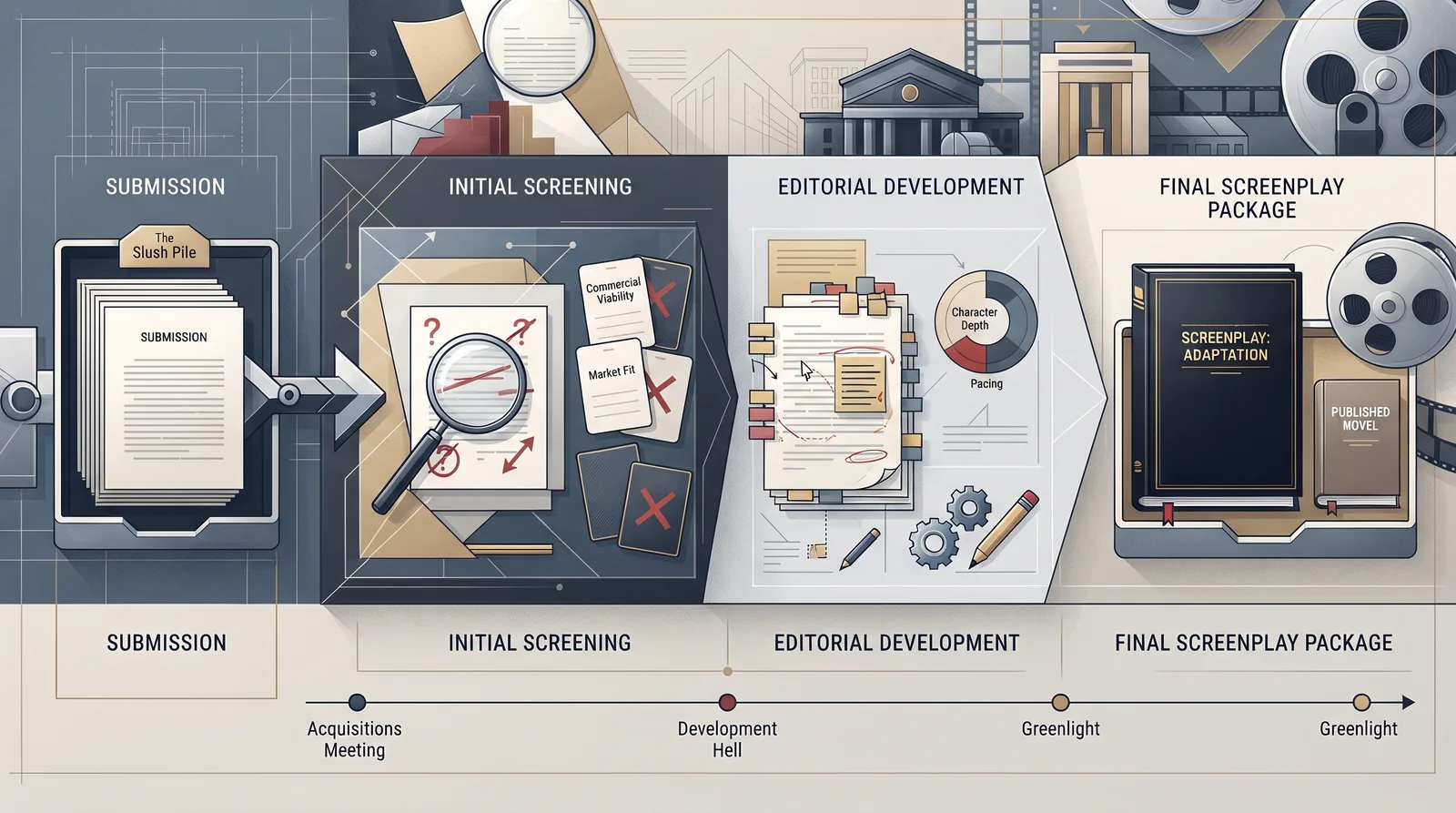
In the industry, the first person to read your script isn’t the director or the star. It is the “Gatekeeper”—usually a junior development executive or a professional reader. Their job is to find any reason to say “No.”
Before a producer or development executive decides whether to spend more time on a screenplay, the project may pass through several layers of professional evaluation. Understanding how those readers approach a script can help writers avoid preventable problems and present the strongest version of their material.
What Happens When a Producer Receives a Script?
A screenplay may be read by different people depending on the production company, studio, agency, manager, or independent producer receiving it. A professional reader or development executive may be responsible for assessing whether the material is worth further consideration.
That evaluation can include several areas:
- Story and structure: Does the screenplay establish a compelling dramatic situation and sustain it through the story?
- Characters: Are the major characters sufficiently developed, motivated, and dramatically engaging?
- Pacing: Does the screenplay maintain momentum, or are there sections where the story begins to lose energy?
- Dialogue: Does the dialogue reveal character and advance the story without unnecessarily explaining information the audience can understand from the action?
- Presentation: Is the screenplay professionally formatted and easy to read?
- Market considerations: Depending on the company and project, readers may also consider genre, audience, comparable projects, budget implications, and the potential audience for the material.
A strong screenplay does not guarantee that a producer will pursue it. Companies receive projects for many reasons, and decisions can depend on factors beyond the quality of the writing. The writer’s goal is to eliminate avoidable reasons for a reader to stop engaging with the material.
What Makes a Script More Likely to Earn Further Consideration?
There is no formula that guarantees a producer will pursue a screenplay. However, writers can improve the material by addressing the factors that make professional evaluation easier.
The premise should be clear enough to understand without a lengthy explanation. The central conflict should generate meaningful consequences. The characters should have understandable objectives and obstacles. The screenplay should maintain momentum without relying on constant exposition. And the writing should allow the reader to visualize the story rather than forcing them to interpret what the writer intends.
Presentation matters as well. Professional formatting does not make a weak screenplay strong, but poor presentation can create an unnecessary barrier between the reader and the story.
Getting a Script Into the Right Hands
A strong screenplay still needs a realistic route to the people who might have an interest in producing it.
That route can vary. Writers may work through representatives, producers, managers, literary contacts, established industry relationships, competitions or labs, pitch opportunities, or other legitimate submission channels.
The important distinction is between having a strong script and having access to an appropriate reader. One does not automatically create the other.
Before submitting, writers should also research the recipient. A production company that develops contained thrillers may have little interest in an expensive historical epic, even if the screenplay is excellent. Matching the project to companies and producers whose interests align with the material can make the submission process more targeted and realistic.
Before You Submit Your Screenplay
Before sending a screenplay to a producer, review the project from the perspective of someone encountering it for the first time.
- Test the premise. Can you explain the central premise clearly and concisely? If the concept requires several paragraphs before the basic story becomes understandable, the screenplay may need a clearer foundation.
- Evaluate the opening. The opening pages establish the characters, situation, tone, and dramatic direction of the screenplay. They should give the reader a clear reason to continue.
- Check the complete story. A compelling opening cannot compensate for a screenplay that loses direction later. Review the entire script for structural problems, weak character motivation, unnecessary scenes, pacing problems, and unresolved storylines.
- Get an objective assessment. Writers are often too close to their own material to identify every problem. An independent evaluation can reveal issues that are difficult to recognize after multiple drafts.
- Research your submission targets. Identify producers and companies whose existing work, genres, budgets, and development interests align with your project. A targeted submission is generally more useful than sending the same material indiscriminately.
What Happens After the Script Is Ready?
Getting a screenplay read is only the first step. If a producer responds positively, the project may still go through development, additional revisions, internal evaluation, packaging, financing, or other stages before production becomes possible.
For writers and rights holders, the most useful approach is therefore to treat the screenplay as a development asset rather than simply a document to submit.
If you want professional feedback on the strengths and weaknesses of your screenplay before approaching producers, you can learn more about our Script Coverage service.
About the Author
Raphael Olanibi is the founder of ScreenwritePro and a professional screenwriter and development specialist. Since 2018, he has worked across original screenplay development, book-to-screen adaptation, treatments, coverage, and script development. Learn more about Raphael Olanibi.