Every author has had the “Closing Credits” dream: sitting in a darkened theater as the story they spent years writing unfolds on the big screen.
But there is a reason so many great books fail to become great movies. The transition from prose to production isn’t a copy and paste job. It is a total translation of form.
A successful adaptation begins with understanding the differences between the two forms. A book can rely on narration, internal thought, extensive description, and hundreds of pages to develop its story. A screenplay has to communicate primarily through scenes, action, dialogue, and visual storytelling.
What Has to Change When a Book Becomes a Screenplay?
The central challenge of adaptation is deciding how the information contained in prose can be communicated through cinema.
A novel can tell the reader what a character remembers, thinks, fears, or believes. A screenplay generally needs to externalize that information through behavior, conflict, dialogue, visual action, or interaction with other characters.
This does not mean every internal thought has to be translated literally. Some material can be removed without damaging the story. Other material may need to be transformed into a scene or action that communicates the same dramatic idea.
The question is not whether every sentence of the book can appear in the screenplay. The question is whether the emotional and dramatic function of the source material survives the transition to the screen.
What Gets Cut From a Book Adaptation?
A screenplay cannot preserve every character, subplot, scene, description, and piece of background from a book.
Some material may be condensed. Some secondary characters may be combined or removed. Subplots may be reduced or eliminated when they do not contribute sufficiently to the central dramatic story. Events may also be reorganized to create a more effective cinematic progression.
The amount of material that changes depends entirely on the source. A tightly plotted novella and a sprawling historical novel will present very different adaptation challenges.
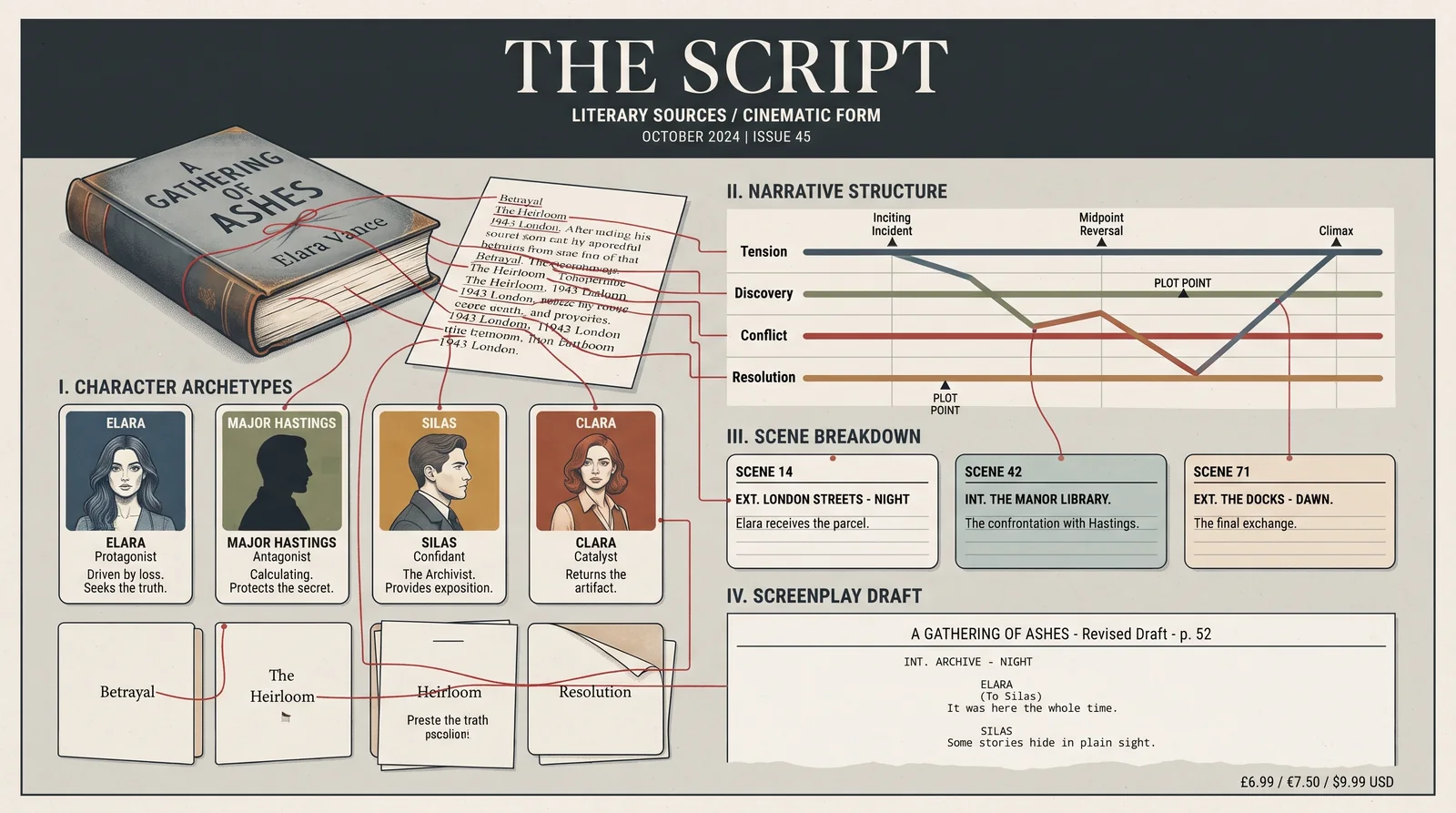
Common Stages of a Book-to-Screenplay Adaptation
Although every project is different, an adaptation commonly involves several stages of development.
- Source analysis: The material is examined to identify the central story, major characters, important conflicts, themes, and elements that are essential to the identity of the work.
- Adaptation planning: Decisions are made about what should be retained, condensed, combined, reorganized, or removed.
- Screenplay development: The selected material is developed into scenes and sequences that follow the requirements of the intended film or television format.
- Revision: The screenplay is refined to address structural, character, pacing, dialogue, and visual storytelling issues.
Can Any Book Be Adapted?
Not every book will translate into a successful screenplay in the same way, and some source material may require substantial restructuring.
Factors such as the strength of the central conflict, the suitability of the characters for screen storytelling, the amount of material that needs to be condensed, the intended format, and the availability of adaptation rights can all affect the process.
For authors and rights holders considering an adaptation, the first useful step is often determining what the strongest screen version of the source material could look like.
If you are ready to explore a professional adaptation of your book, you can learn more about ScreenwritePro’s Book-to-Screenplay Adaptation service.