
Written by Raphael Olanibi, Founder, ScreenwritePro | Screenwriter & Development Specialist
Science fiction and fantasy novels create a particular problem for screen adaptation.
The problem is usually the amount of world that has to be understood before the story can function.
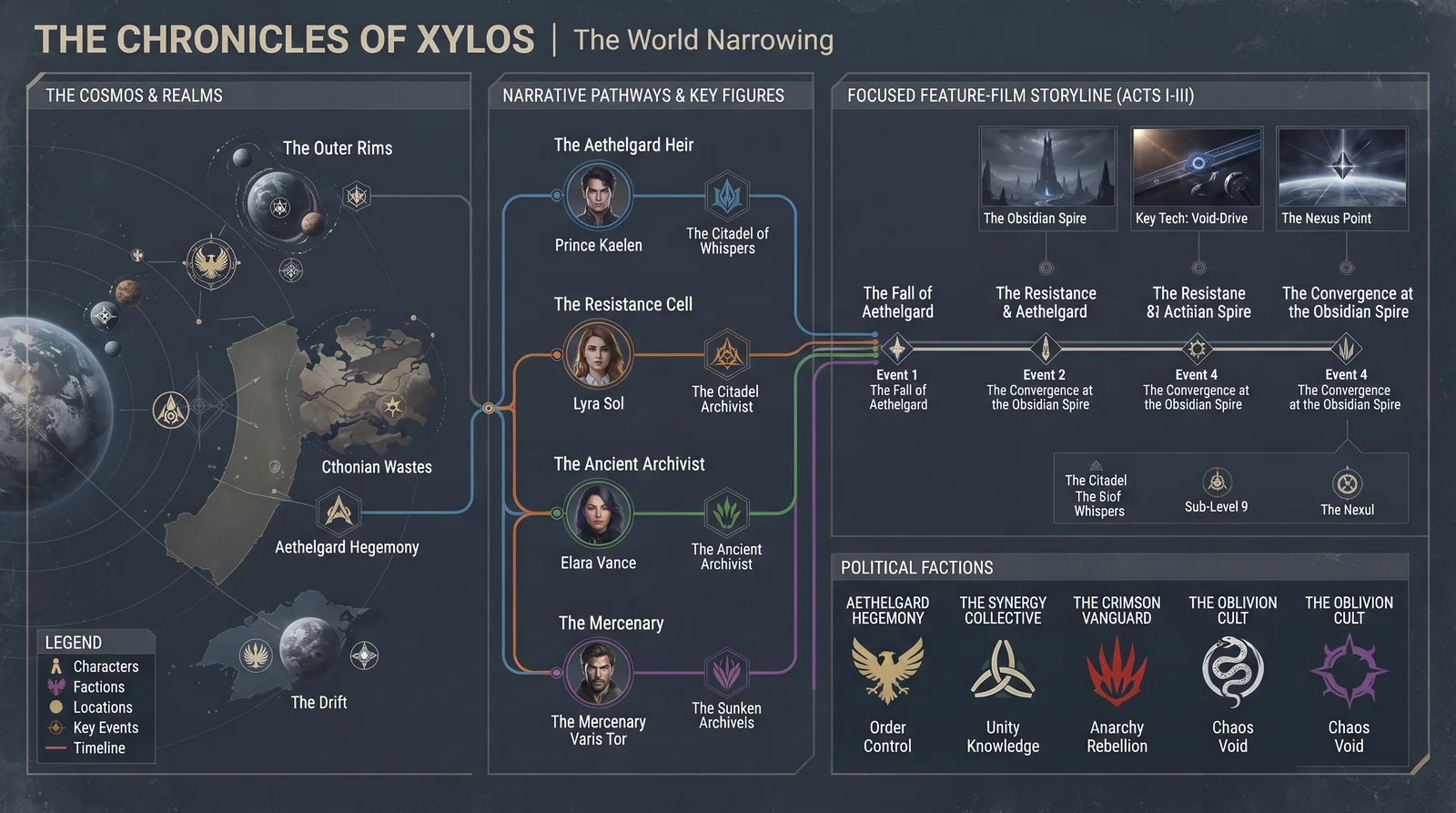
A fantasy novel may contain multiple kingdoms, ancient histories, competing religions, magical systems, political factions, invented languages, family lineages, creatures, prophecies, wars, and hundreds of years of mythology.
A science fiction novel can create equally complex challenges through futuristic technology, alien civilizations, scientific concepts, political systems, artificial intelligence, multiple planets, invented terminology, and unfamiliar social structures.
A screenplay has to make the audience understand enough of that world to follow the story without turning the first act into a history lesson. That is the central challenge of adapting expansive speculative fiction.
Why World-Building Becomes Difficult During Adaptation
Authors can spend hundreds of pages establishing a fictional world because readers have time to absorb it gradually. A screenplay has far less room. The audience may encounter a new kingdom, technology, species, political conflict, magic system, historical event, and unfamiliar terminology within the same sequence.
If all of this information is explained through dialogue, the screenplay can become exposition-heavy before the central story has properly developed. This creates a common adaptation problem.
The writer becomes so focused on explaining the world that the characters stop doing things inside it. The story begins to feel like a presentation about the fictional universe rather than a dramatic narrative taking place within that universe.
What Does the Audience Actually Need to Know?
A useful adaptation process begins by separating the author’s complete knowledge of the world from the audience’s immediate requirements. These are not the same thing.
The author may know the complete history of the civilization, every political faction, the origins of the magic system, the genealogy of important families, the history of previous wars, the rules governing different technologies, the names of dozens of locations, the mythology surrounding the central conflict, and events that occurred centuries before the story begins.
The audience may only need to know enough to understand who the protagonist is, what the protagonist wants, what stands in the way, what kind of world the protagonist lives in, which rules affect the current conflict, why the central threat matters, and what consequences follow from the protagonist’s decisions.
The rest can be introduced when the story makes it relevant. This is particularly important when adapting a fantasy novel for film or converting a large science fiction property into a screenplay.
The World Should Be Revealed Through the Story
One of the most effective ways to handle complex world-building is to make the audience discover the world through character experience. Instead of explaining that a particular magical ability has existed for centuries, show the consequences of that ability. Instead of explaining the entire political structure of an empire, show the political conflict that affects the characters.
This approach also creates a more natural relationship between exposition and story. A character does not need to explain something merely because the audience does not know it. The character should have a reason to discuss it.
The Difference Between World-Building and Exposition
World-building and exposition are related, but they are not the same.
World-building establishes the rules, environment, culture, history, technology, social structures, and conditions that make the fictional world distinctive.
Exposition communicates information to the audience.
A screenplay can contain extensive world-building without lengthy exposition. For example, if a society treats a particular technology as ordinary, characters may interact with it without explaining its existence. The audience learns that the technology is normal because everyone behaves as though it is normal.
The same principle applies to fantasy.
If magic is part of everyday life, characters do not necessarily need to stop and explain that magic exists. Their behavior can establish that fact. The screenplay can then reserve explicit explanation for rules that directly affect the dramatic situation.
Establish the Rules That Matter to the Story
Complex speculative stories often contain elaborate systems. Magic has rules. Technology has limitations. Political systems have consequences. These details can be important, but the screenplay does not necessarily need to establish every rule.
It needs to establish the rules that affect the audience’s understanding of the story.
Suppose a character possesses an ability that can solve almost any problem. If there are no meaningful limitations, dramatic tension can disappear. The audience begins asking why the character does not simply use the ability whenever there is a problem. That is why rules matter.
The screenplay should make clear enough about the system that the audience understands what characters can do, what they cannot do, and what using those abilities costs.
The “Rule Before Payoff” Principle
If a world-building rule becomes important to resolving a major conflict, the audience should generally have enough information about that rule before the payoff occurs. Otherwise, the resolution can feel arbitrary.
Imagine a protagonist suddenly discovering that an ancient artifact can defeat the central antagonist because of a rule that was never established. The audience may understand what happened, but they may not feel that the story earned it.
A better structure establishes the relevant rule earlier. The audience may not know exactly how it will become important, but the information exists before the payoff. This creates a sense of narrative logic. The same principle applies to limitations.
If a character’s ability has a significant weakness, establishing that weakness before the climax allows the eventual conflict to feel consequential rather than manufactured.
How to Handle Invented Terminology
Authors may have created hundreds of terms for places, species, technologies, political groups, religions, weapons, historical periods, and magical abilities. Readers can refer back to a glossary or gradually become familiar with the terminology. Film audiences cannot easily do that.
Too many unfamiliar terms introduced too quickly can create cognitive overload. This does not mean the screenplay should eliminate the world’s distinctive language. Terminology should be introduced strategically. If three fictional terms are introduced in the same scene, the audience may struggle to understand which ones matter.
A strong adaptation asks: does the audience need to remember this term? If not, simpler language may be more effective.
The Protagonist Should Be the Audience’s Entry Point
One of the most useful tools for adapting complicated world-building is the protagonist. The audience should experience the world through someone whose immediate objectives give the information meaning. This becomes particularly useful when the protagonist is unfamiliar with some aspect of the world.
A character who has never encountered a particular technology, political faction, magical ability, or location may naturally ask questions that the audience also has. But this technique should not become an excuse for endless explanatory dialogue. The character’s curiosity needs to arise from the situation.
Do Not Adapt the Encyclopedia
One of the biggest mistakes in a large-scale fantasy or science fiction adaptation is attempting to preserve the entire fictional universe. The result can become a screenplay that contains too many characters, too many locations, too many factions, too many historical references, too many rules, too many plotlines, too many explanations, and too many competing conflicts.
The screenplay may technically contain everything. It may also leave the audience unsure what the actual story is. A feature screenplay needs hierarchy, because not every character is equally important and not every location deserves equal screen time.
The adaptation needs to determine what the audience should understand, what they should experience, and what can remain unexplained until later.
How to Decide What Survives
During development, expansive source material can be evaluated according to several questions. Does it affect the central conflict? Does it affect a major character? Does it establish an important rule? Does it create a payoff? Does it make the world distinctive? Does it exist only because the author knows it?
Large Casts Require Greater Discipline
Fantasy and science fiction novels often have large ensembles. That can become difficult on screen. The screenplay needs to distinguish between primary characters whose decisions drive the central story, supporting characters who significantly affect the protagonist or central conflict, functional characters who perform a specific narrative function but may not require extensive development, and background characters who establish the world but do not require substantial narrative attention.
Some characters may need to be combined. Others may disappear entirely. This can be difficult for authors because a character who appears minor within the screenplay may have considerable importance elsewhere in the larger literary universe. The adaptation should therefore consider the intended format.
A feature film, limited series, and ongoing television series offer very different amounts of narrative space.
When a Feature Should Become a Series
Sometimes the problem is not that the adaptation is poorly structured. The source material may simply contain too much story for one feature. A sprawling fantasy novel with several major character arcs, multiple locations, competing factions, and a large-scale conflict may require a limited series or ongoing series rather than a single film.
The format should therefore be considered early.
A useful adaptation assessment can examine the amount of source material, the number of major characters, the number of independent storylines, the scale of the world, the number of locations, the complexity of the central conflict, the number of major turning points, the amount of character development required, whether the story has natural episode breaks, and whether the source contains multiple complete dramatic arcs.
Choosing the wrong format can create problems that no amount of line editing will solve.
The World Should Change the Characters
The strongest speculative fiction does more than place ordinary characters in an unusual environment. The world affects how characters think, behave, make decisions, and pursue their objectives. If the story takes place in a society where a particular technology is common, that technology should influence behavior.
If magic determines social status, characters should respond to that system. If resources are scarce, scarcity should affect decisions. If political authority controls access to something important, that power should create conflict. This is where world-building becomes dramatically useful.
Avoid Explaining What the Audience Can Understand
A common problem in speculative screenwriting is explaining information that the audience can already infer.
If two characters walk through a city where enormous machines dominate the skyline, the screenplay may not need a paragraph explaining that the society has advanced technology. Visual storytelling can carry substantial world-building information. This is one of the reasons adaptation requires a different approach from prose.
A Practical Adaptation Framework for Complex Worlds
When approaching a large science fiction or fantasy property, the development process can be organized around several layers.
Layer One: The Story — What is the central dramatic story? Who is the protagonist? What do they want? What prevents them from getting it? What happens if they fail?
Layer Two: The World — What aspects of the fictional world directly affect that story? Which rules, technologies, cultures, political systems, or supernatural elements must the audience understand?
Layer Three: The Characters — Which characters are necessary to carry the story? Which characters can be combined? Which relationships create the strongest dramatic pressure?
Layer Four: The Rules — What rules must be established for the audience to understand the conflict? What limitations prevent characters from solving every problem easily?
Layer Five: The Scale — What format best accommodates the material? Does the story require a feature? Would it benefit from a limited series? Does the source contain enough continuing material for an ongoing series?
Layer Six: The Cinematic Expression — How can the world be communicated through scenes, behavior, production design, action, conflict, and visual storytelling?
This framework allows the adaptation to preserve the distinctive qualities of the source without forcing the screenplay to carry the entire novel.
A Successful Adaptation Does Not Need to Explain Everything
One of the most important lessons when adapting a sci-fi book into a screenplay is that mystery can be useful.
The audience does not need complete knowledge of the fictional universe on page one. They need enough information to understand the immediate situation. Some questions can remain unanswered. Some history can remain mysterious.
The difference is whether the audience understands what is happening now. Mystery makes an audience want to learn more. Confusion makes them struggle to understand the story.
Final Takeaway
The larger the fictional world, the more selective the adaptation process has to become.
A sprawling science fiction or fantasy novel may contain enough material for several screen projects. Trying to preserve all of it can weaken the screenplay by burying the central story beneath information.
The solution is not to make the world smaller for the sake of simplicity. It is to determine which parts of the world matter most to the story being told.
The strongest sci-fi and fantasy screenplay adaptations preserve the elements that make the source distinctive while transforming the material into something that works through scenes, characters, conflict, images, and action.
If you have written a science fiction or fantasy novel and are considering adapting it for film or television, ScreenwritePro can assess the source material, identify its strongest cinematic elements, and develop an adaptation suited to the intended screen format.
Explore ScreenwritePro’s Book-to-Screenplay Adaptation service.