In Hollywood, there is a saying: “Great scripts aren’t written; they are rewritten.”
Almost every major studio blockbuster has been through the hands of a Script Doctor—a specialist brought in to sharpen the dialogue, fix structural leaks, and ensure the pacing never falters. But for the independent filmmaker or author with a self-adapted draft, the rewrite process often feels like a guessing game.
If you are receiving polite passes from producers or if your project has stalled in the development phase, you likely have an execution problem.
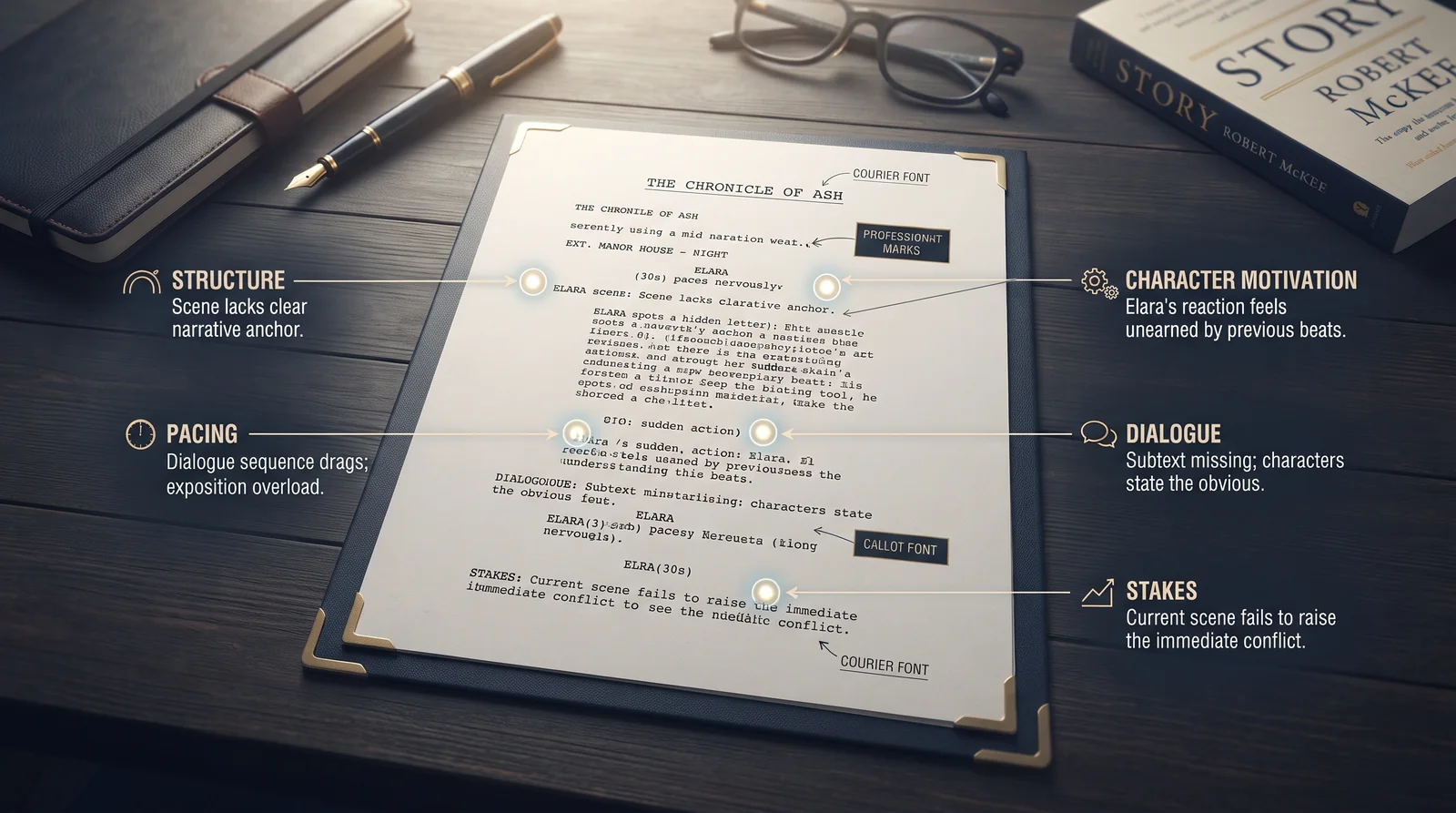
Across more than 100 screenwriting and development projects, our team has encountered a wide range of structural, character, dialogue, pacing, and development changes. Here are the five definitive signs that it’s time to stop editing and start doctoring.
1. The “Ten-Page” Rejection
If readers are putting your script down before the midpoint, your Inciting Incident or your Hook is weak. Producers make a decision in the first ten pages. A script doctor ensures that your opening isn’t just good, but undeniable.
2. The “On-the-Nose” Dialogue Trap
One of the clearest signs of an amateur draft is dialogue that explains exactly what the characters are feeling. Professional scripts live in the subtext. Our doctoring service focuses on giving your characters distinct, cinematic voices that sound like real people, not plot-delivery devices.
3. The Sagging Second Act
This is where 90% of scripts fail. If your story loses momentum between page 30 and page 90, the stakes aren’t high enough. We specialize in the Midpoint Trajectory, the technical beat that re-energizes a story and carries it toward a climactic third act.
4. Your Genre Beats are Missing
Whether you are writing one of our specialty thrillers or an historical epic, every genre has rules. If your thriller doesn’t have tension leaks every ten pages, or if your romance lacks the “All is Lost” moment, the market will reject it. We ensure your script hits the specific tropes that distributors are looking for.
5. You Are Too Close to the Material
Authors adapting their own books often struggle to cut scenes that they love but that the movie doesn’t need. A script doctor provides the objective, cold-blooded perspective required to kill your darlings for the sake of the story.
What Kind of Help Does a Struggling Screenplay Need?
Not every screenplay with problems needs a complete rewrite.
A draft with a strong structure but weak dialogue may benefit from targeted revisions. A screenplay with a promising concept but major structural problems may require more substantial development.
An independent assessment can help determine the scale of the problem before deciding how much rewriting is appropriate.
This distinction matters because rewriting more pages does not necessarily produce a better screenplay. The goal is to identify the underlying problem and make the changes required to solve it.
What Happens After a Script Is Reworked?
Once the major problems in a screenplay have been addressed, the writer still needs to evaluate the new draft as a complete piece of work.
A rewrite should be read from beginning to end rather than judged only by the scenes that were changed. Structural improvements can affect pacing, character arcs, setup and payoff, continuity, and the overall experience of the story.
The revised screenplay should also be evaluated against its intended audience, genre, format, and production context before it is submitted for professional consideration.
When Should You Bring In a Script Doctor?
If you have revised the screenplay repeatedly but continue to encounter the same problems, outside feedback can help identify what the writer has become too close to see.
A script doctor may be useful when the concept is promising but the execution is not faulty, when feedback from multiple readers points to recurring problems, or when the writer cannot determine which changes would improve the draft.
If you want an objective assessment of your screenplay before deciding whether it needs a polish or a more substantial rewrite, you can learn more about ScreenwritePro’s Script Coverage service.